
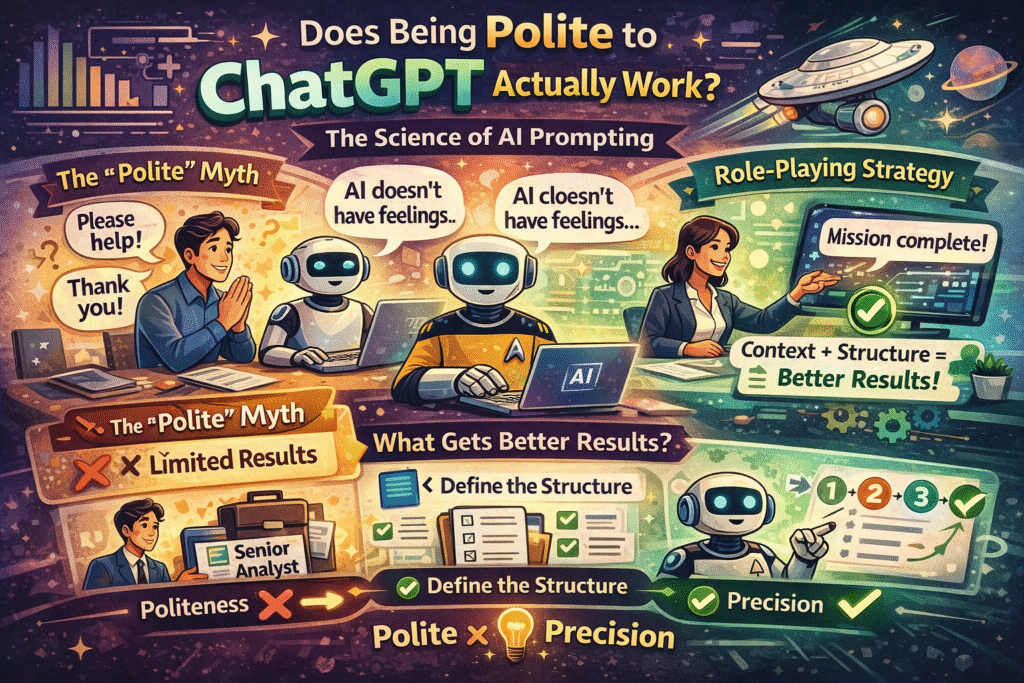
Does Being Polite to ChatGPT Actually Work? think twice before you say “Please.” We’ve all done it treating ChatGPT like a real person by adding “please” and “thank you.” But in the world of Generative AI, does politeness actually lead to better results? Or are we just wasting our keystrokes?
The Myth of the “Polite” Robot
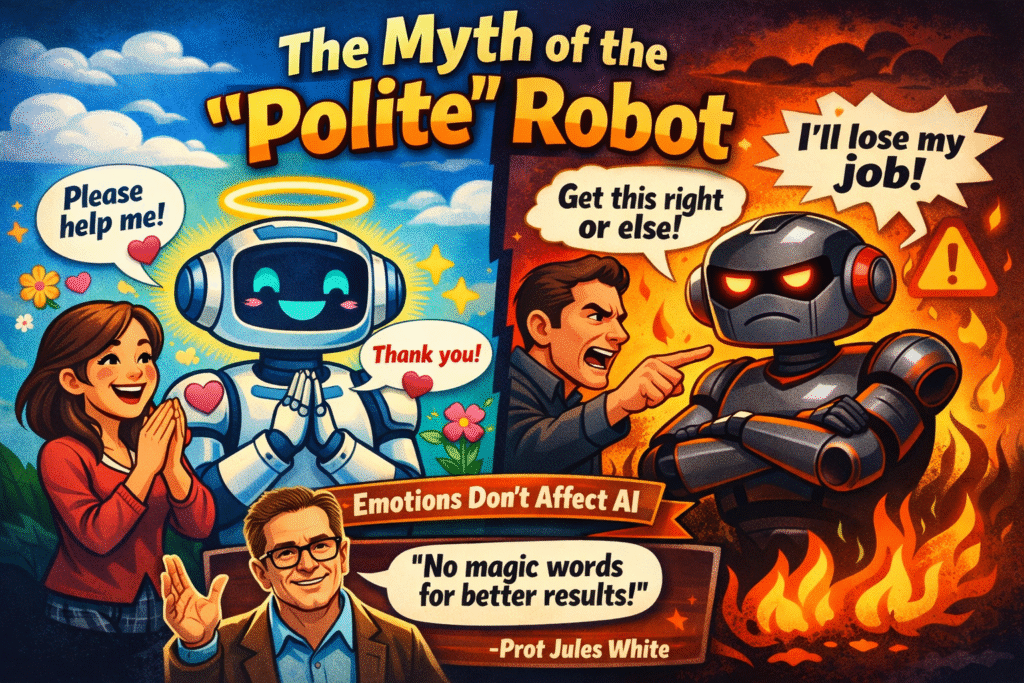
Does Being Polite to ChatGPT Actually Work? many users believe that being kind makes AI more cooperative. Conversely, some “power users” swear by “threatening” the AI (e.g., “I’ll lose my job if you get this wrong”).
However, research suggests these emotional triggers are inconsistent. According to Jules White, a professor at Vanderbilt University, there isn’t a “magic word” that unlocks better performance. AI doesn’t have feelings to hurt it has patterns to follow.
The “Star Trek” Strategy: Why Context Wins

Interestingly, researchers found that while “positive thinking” didn’t help much, role-playing did. When an AI was told to pretend it was on a Star Trek mission, its mathematical accuracy spiked.
This is what experts call Context Engineering. It’s not about the words you choose; it’s about the framework you build for the AI to work within.
3 Tips for Better AI Results (That Actually Work)
Instead of focusing on manners, try these proven techniques:
- Assign a Persona: Tell the AI who it is (e.g., “You are a senior data analyst at a Fortune 500 company”).
- Define the Structure: Don’t just ask for a summary; ask for “three bullet points and a concluding sentence.”
- The “Think Step-by-Step” Hack: Simply asking the AI to “think carefully” or “explain your logic step-by-step” is far more effective than being polite.
Conclusion
You don’t have to be polite to AI, but you do have to be clear. While saying “please” won’t hurt, focusing on “Context Engineering” is what will truly take your AI game to the next level.
Reference:https://share.google/jQ4erRO0GPmRHrQkp